Jamia Millia Islamia (A Central University by an Act of Parliament)
NAAC Accredited 'A++ Grade'
|| Department of Chemistry||

ATSLAB: Amit's Theory & Simulation Laboratory

Shelly Bhardwaj
Prime Minister's Research Fellow (PMRF)
Department of Chemistry (Faculty of Natural Sciences),
Jamia Millia Islamia (A Central University by an act of Parliament),
New Delhi, India.
About Me
I am currently a research scholar under Prime Minister's Research Fellow (PMRF) scheme at Department of Chemistry (Faculty of Natural Sciences), Jamia Millia Islamia (A Central University by an act of Parliament), New Delhi advised by Dr. Amit Kumar. My aspiration is to continually enhance my scientific acumen by immersing myself in the vast and diverse landscape of this field. I am eager to explore its concepts and visions, using them to contribute to cutting-edge research in Polymer Physics. Seeking an academic position that stimulate opportunities for advanced research in this realm, I am poised to make significant strides towards unraveling the mysteries of polymer science and its applications.
Education
Jamia Millia Islamia,
(A Central University), New Delhi
Ph.D. Student (Chemistry)
Research Advisor: Dr. Amit Kumar
2021 - Present
Amity University,
Noida, Uttar Pradesh
M.Sc. in Chemistry
2017-2019
Rajdhani College,
University of Delhi, New Delhi
B.Sc. (H) Chemistry
2014-2017
CONFERENCES & Certificates
Jawaharlal Nehru University| International Conference
FEBRARY 2019
Multiscale Simulation & Mathematical Modelling of Complex Biological systems
Jawaharlal Nehru University| International Conference
APRIL 2020
COVID 19 Pandemic: Challenges and Recent Advancements
Jamia Millia Islamia (A Central University) | Centre for Advanced Computational Chemistry Studies
AUGUST 2022
Workshop on Computational Chemistry of Materials: Molecule, Solids, Nanoparticles and Biological Activity
TATA Institute of Fundamental Research | International Centre for Theoretical Sciences
OCTOBER 2022
Statistical Biological Physics: from Single Molecule to Cell
Bhau Rao-Devras Shodh Peeth | University of Lucknow
AUGUST 2023
Skill Panorama on Research Methodology Based Data Analysis Using R
Deshbandhu College | University of Delhi
OCTOBER 2023
Theoretical Perspective on Segmental Relaxation Dynamics of Model Dendrimers
Jawaharlal Nehru University| One-day Symposium
MARCH 2024
Simulation of Physical and Biological Systems
Jamia Millia Islamia Univeristy| One-week worshop
SEPTEMBER 2024
Advanced Drug Designing and Computational Biology

Teaching Duties
Teaching undergraduate students at Deshbandhu College, University of Delhi (February 2023 - till Date)
Research
Background
Understanding how the underlying geometries and in particular the topologies of polymeric materials affect their dynamic behavior is one of the fundamental difficulties in polymer physics. This issue has a lengthy history and is growing more significant as new polymeric materials with increasingly intricate topologies are created. Being complex systems, polymers exhibit a variety of dynamic characteristics that cannot be fully understood without illuminating the relationships between structure and dynamics. Theoretical frameworks that enable analytical insights into this issue are therefore quite valuable. Rouse's innovative theories, which began with the bead-and-spring model for linear flexible chains, led to the creation of a fundamental strategy that could be utilized to comprehend the dynamical behavior of polymers. The purpose of this coarse-grained model is to investigate dynamical properties of flexible and semiflexible macromolecules on sizes greater than the range of a few monomers.
1. Structural Modulation in Comb Polymers through Topology, 2025, Under communication
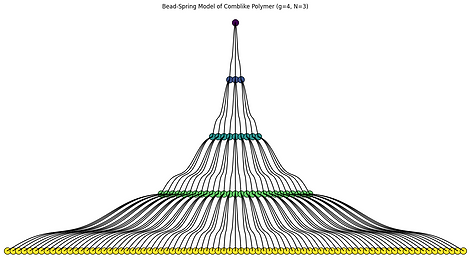
2. Unraveling the Influence of Excluded Volume on Orientational Relaxation Dynamics in Dendrimers, Just Accepted under Physical Chemistry Chemical Physics, 2025.
This study investigates the orientational relaxation dynamics of flexible dendrimers while incorporating excluded volume interactions among non-bonded monomers using the optimized Rouse-Zimm formalism. Excluded volume effects are modeled as an effective co-volume between adjacent non- bonded monomers through a delta function pseudopotential, while hydrodynamic interactions are accounted for using the preaveraged Oseen tensor. This work examines P(i)2 (t) as a function of dendrimer generation and the strength of excluded volume interactions between nearest non-bonded monomers. The theoretical framework builds upon the work of [Kumar and Biswas (Phys. Chem. Chem. Phys., 2013, 15, 20294)], which analyzed orientational relaxation in semiflexible dendrimers but did not consider excluded volume interactions. The temporal decay of P(i) 2 (t) at varying excluded volume parameters, vθ and vψ , shows trends consistent with experimental observations under different temperatures, [Yimer and Tsige, (J. Chem. Phys.,) 2012, 137, 204701.] The spectral density, J(ω), obtained via the Fourier cosine transform of P(i)2 (t), is significantly influenced by excluded volume interactions. In the high-frequency regime, J(ω) decreases with increasing frequency, exhibiting a crossover pattern as excluded volume interactions vary in the intermediate frequency range. The area under the spectral density curve increases as the excluded volume parameters vθ and vψ decrease. The reduced spin-lattice relaxation rate, [1/T1H ], follows a power-law scaling in the intermediate frequency regime, with exponents dependent on dendrimer generation and the strength of excluded volume interactions. Notably, for generation G = 5, the calculated scaling exponent at vθ = 0.24 and vψ = 2.12 aligns precisely with experimental data, validating the theoretical model. The spin-spin relaxation rate, [ 1/T2H], exhibits a distinct trend influenced by excluded volume interactions. In the intermediate frequency regime, its scaling behavior is closely linked to structural constraints and segmental motion, deviating from [ 1/T1H] at lower correlation times due to enhanced low-frequency contributions. However, for generation G = 5, [ 1/T2H] follows a similar trend to [ 1/T1H] and aligns well with experimental observations.


3. Analytical model to deduce the conformational and dynamical behavior in dendrimers: A Review, Polymers 2024, 16(13), 1918; https://doi.org/10.3390/polym16131918
Our review utilises an optimized Rouse-Zimm discrete hydrodynamic model and the preaveraged Oseen tensor, which accurately consider hydrodynamic interactions. We report the analytical theories that have been previously developed for the creation of generalised analytical models for dendrimers. These generalized theories were used to assess the conformational and dynamical behaviour of the dendrimers. By including stiffness in the bonds, the neglect of excluded volume interactions may be somewhat offset. This is true at least in the case of short spacers. While the topological limitations on the directions and orientations of the individual bond vectors in dendrimers implement semiflexibility. The intensity of these contacts were determined by the potential geometric orientations of the bonds, and later on the excluded volume interactions in dendrimers, which were described in terms of the effective co-volume between nearest non-bonded monomers, modelled using the delta function pseudopotential. With the aid of the models developed, the authors condensed various conformational and dynamic properties on dendrimers that depend on their degree of semiflexibility and strength of excluded volume. Semiflexibility accurately compensates for the volume interactions that are not included in the modelling. These analyses come to the conclusion that the flexible dendrimer in one limit and the earlier described freely rotating model of dendrimers in the other constitute a highly generalised way to capture a wide range of conformations in the developed mathematical model in dendrimers.

Simple bead-spring model dendrimers are shown schematically along with four different types of generated conformations in semi-flexible dendrimers: (A) compressed conformations, (B) expanded conformations, (C) freely rotating conformations, and (D) La Ferla’s model dendrimers.

The closest non-bonded connections between monomers from the same generation and generations before it in the model dendrimer.
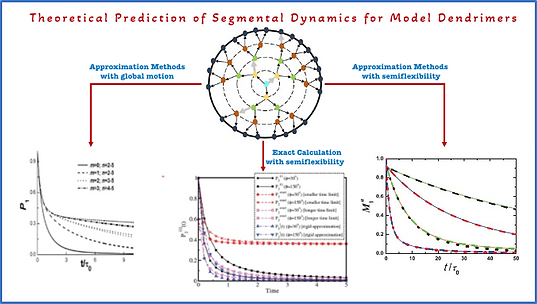
4. Theoretical Perspective on Segmental Relaxation Dynamics of Model dendrimer, Chemical Physics, 586 (2024) 112393
The internal segmental diffusion and the relaxation modes are investigated, and the relationship between the topology of model dendrimers is established, all within the bounds of analytical and simulation approaches. The precise theoretical and simulation approaches are thoroughly described after sufficient data is provided for model theories and their predictions. The analytical framework of the Generalised Langevin Equation is exactly replicated in the results. The primary focus of this review is on the NMR technique for forecasting the occurrence of the prominent processes, such as bond pulsation, segment reorientation, and total dendrimer rotation, utilising the relaxation spectrum at various time scales. The utilization of two autocorrelation functions, namely time and orientational, is given significant emphasis. These functions illustrate the mobility of branches and their dependence on the generation number.
experience
-
April, 2024------: Teaching Assistant | Shri Tula Ram Public School.
-
April, 2022------: Teaching Assistant | Department of Chemistry, Jamia Millia Islamia Univeristy.
-
April, 2022- March 2024: Teaching Asistant | Deshbandhu College, Noida, Department of Chemistry, UNiversity of Delhi.
-
January - April, 2020: Visiting Faculty | Amity University, Noida, Uttar Pradesh. Visiting faculty, course: B.Tech. Engineering Chemistry (Chem136).
-
May - June, 2018: Research Internship | Department of Chemistry, University of Delhi, Internship on the topic “Designand synthesis of bioactive isatin based heterocyclic scaffolds”.
-
2018-2019: Research Internship | Department of Chemistry, University of Delhi, Internship on the topic “Synthesis of PEG based pyrano-pyrazole scaffolds for amphiphilic drug delivery application”.
-
2016-2017: Research Internship | Rajdhani College, University of Delhi, Innovation Research Project Student, worked in “Conductometric & spectrometric study of Micellization behaviour of surfactant”.